
Shopify vs Custom Ecommerce Website: Which Wins in 2026?

Shopify vs Custom Ecommerce Website Development: The Honest 2026 Breakdown
You're ready to sell online. Products are sorted, branding is done, pricing is figured out. Now comes the question every new ecommerce business owner faces:
"Should I just use Shopify — or build something custom?"
Shopify is everywhere. It's the default recommendation you'll get from most freelancers, YouTube tutorials, and marketing blogs. And it genuinely works for a lot of businesses.
But "works" is doing a lot of heavy lifting in that sentence.
This guide gives you the full picture — real costs, real limitations, real advantages on both sides — so you can make the right decision for your specific business before you spend a dollar.

What We're Actually Comparing
Before getting into the numbers, let's be precise about what "custom ecommerce website development" means — because the term gets used loosely.
Shopify (and platforms like WooCommerce, BigCommerce, Wix Stores): You pick a theme, customize colours and images, add your products, and launch. Your store runs on Shopify's servers, Shopify's infrastructure, using Shopify's code. You pay a monthly subscription forever. You don't own the store.
Custom Ecommerce Website: A development team builds your online store from scratch — using modern technologies like Next.js, React, and a secure custom backend. The design is unique to your brand, the code is engineered for your specific products and business logic, and when it's done, every line of that code belongs to you.
Those aren't minor differences in approach. They produce fundamentally different businesses.
The Cost Comparison Nobody Shows You Honestly
Most Shopify comparisons show you the monthly price. That's the beginning of the story, not the whole picture.
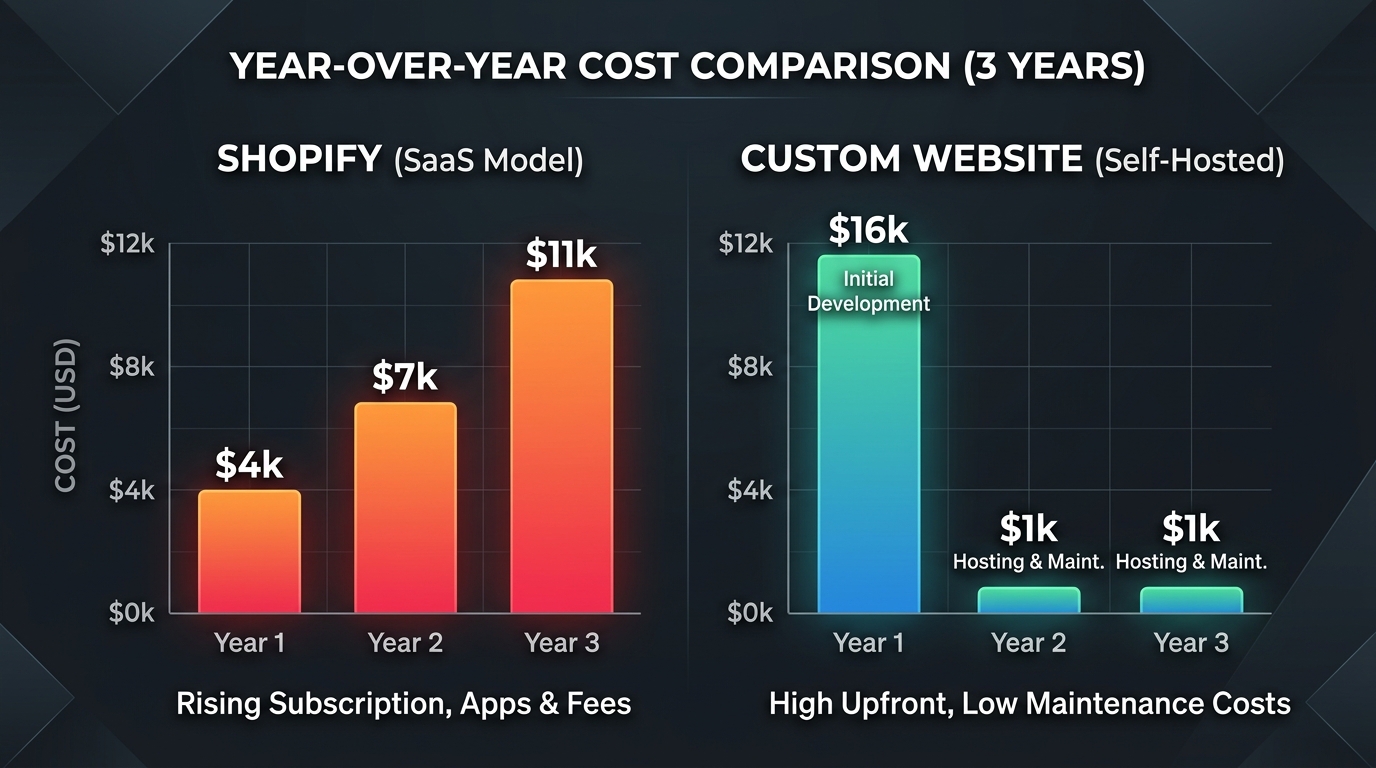
Shopify's Real Cost Over 3 Years
Cost | Monthly | 3-Year Total |
|---|---|---|
Basic Plan | $39/month | $1,404 |
Shopify Plan (most businesses need this) | $105/month | $3,780 |
Transaction fees (if not using Shopify Payments) | 0.5%–2% per sale | Varies |
Premium theme | One-time $200–$500 | $350 avg |
Essential apps (reviews, upsell, email, etc.) | $50–$200/month | $5,400 avg |
Total — 3 years | $9,000–$15,000+ |
And at the end of those 3 years? You own nothing. You're still paying the same subscription, or more — Shopify has raised prices three times in the last four years.
Custom Ecommerce Website — Real Cost
Cost | Amount |
|---|---|
Custom development (full store) | $4,000–$12,000 one-time |
Hosting (your own server) | $10–$30/month |
Domain | $15/year |
Payment gateway (Stripe) | 2.9% + 30¢ per transaction |
3-year total | $5,000–$14,000 |
The math: A custom store often costs the same or less than Shopify over three years — and at the end, you own an asset, not a subscription.
The real financial question isn't upfront cost. It's: what is the 5-year cost of a platform you'll never own?
Speed — Where the Gap Is Undeniable
In 2026, if your site takes more than three seconds to load, you lose nearly half your visitors. Google uses Core Web Vitals as a ranking factor — a slow site doesn't just lose customers, it loses its spot in search results.
Shopify's speed problem:
Shopify themes come pre-loaded with JavaScript for features you may never use. Every app you add (and you will add apps — reviews, wishlists, upsells, loyalty programmes) loads its own scripts. This stacks up fast.
A standard Shopify store with 5–8 apps installed typically scores 45–65 on Google PageSpeed Mobile — well below the threshold Google rewards in rankings.
Custom ecommerce development:
When built correctly on Next.js with proper image optimization, code splitting, and a CDN like Cloudflare, a custom ecommerce store routinely scores 90–98 on PageSpeed Mobile. Every feature is built specifically for your store — no bloat, no unused code, no third-party scripts fighting for bandwidth.
That speed difference translates directly to:
✅ Higher Google rankings (speed is a confirmed ranking factor)
✅ Lower bounce rates (faster pages = visitors who stay and buy)
✅ Higher conversion rates (Amazon found a 1-second delay costs 7% of conversions)
SEO — The Difference That Compounds Over Years
This is where businesses feel the gap most painfully — not in year one, but in year two when they wonder why competitors are outranking them despite having inferior products.
What Shopify Limits You On
URL structure: Shopify forces /products/ in all product URLs and /collections/ in category URLs. You cannot change this. Clean, keyword-rich URLs rank better — and you can't optimize what you can't control.
Code control: You cannot modify Shopify's core rendering. If Google's crawler has trouble rendering your Shopify store (which happens with heavy app stacks), you cannot fix the root cause.
Duplicate content: Shopify creates duplicate URLs for products that appear in multiple collections. For example, a product in both "Men's Jackets" and "Sale" gets two URLs. This confuses Google about which version to rank. Shopify's canonical tag handling helps, but doesn't fully solve it.
Page speed SEO impact: As covered above — Shopify scores hurt organic rankings directly.
What Custom Development Gives You
With custom ecommerce website development, you have complete control over:
URL structure — clean, keyword-optimized paths for every product and category
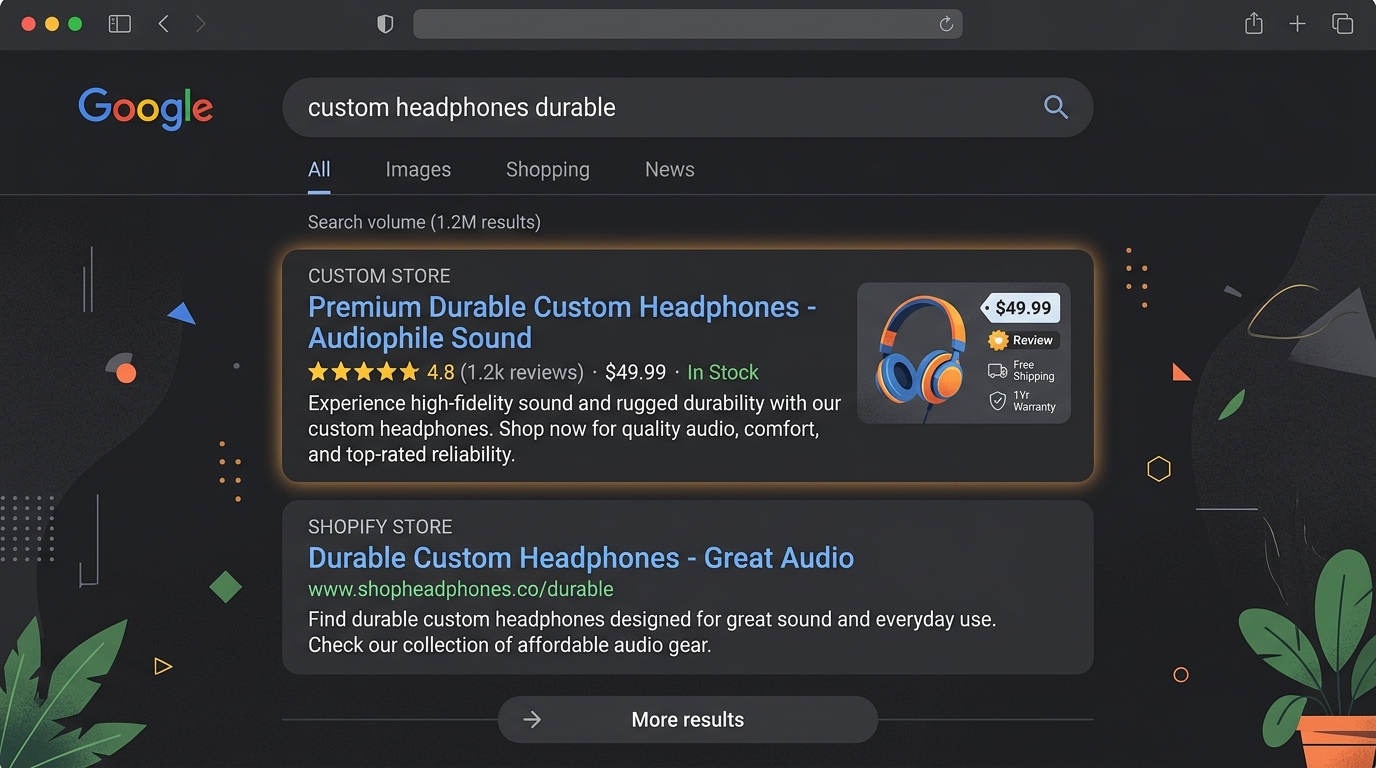
Schema markup — Product, Offer, Review, and BreadcrumbList schemas that generate rich results in Google (star ratings, prices, availability directly in search results)
Rendering — Server-side rendering on Next.js means Google reads your product content as clean HTML, not JavaScript it has to render and interpret
Page architecture — category pages, filter pages, and collection pages structured exactly how Google wants to see them
Internal linking — built into the structure, not retrofitted through apps
The compounding effect: a custom ecommerce store built right in 2026 will organically outrank Shopify competitors for the same products within 6–12 months — without spending more on ads.
The Ownership Question — Most People Miss This Entirely
Your product catalog, customer data, and order history become one of your most valuable business assets — guiding everything from pricing to marketing spend.
On Shopify, that data sits on Shopify's servers. You can export it, but you can't take the store with you. If Shopify:
Raises prices (they have, repeatedly)
Changes their terms of service
Removes a feature you depend on
Gets acquired and pivots the product
Goes down during your busiest sales period
...your options are limited. You're a tenant in someone else's building.
With a custom ecommerce website, you own:
Every line of source code
Your hosting environment
Your database and all customer data
The ability to move, modify, or hand off to any developer
It's the difference between renting and owning. One builds equity, one doesn't.
When Shopify Actually Makes Sense
To be fair — Shopify is genuinely the right choice for some situations:
Start with Shopify if:
You're testing a product idea with no proven demand yet — launching fast matters more than optimization
Your catalog is under 50 products and unlikely to grow complex
You have zero technical budget and need to launch this week
You're doing a short-term product drop or limited-run campaign
Move to custom when:
You're generating consistent monthly revenue and want to own your infrastructure
You're spending $100+/month on Shopify apps to get features your store needs
Your store loads slowly and it's affecting your ad campaign performance
You need features that Shopify apps don't offer — custom pricing logic, B2B portals, subscription models, unique checkout flows
You're serious about organic SEO as a long-term traffic strategy
What Custom Ecommerce Development Actually Includes
When a serious ecommerce development company builds your custom store, you're not just getting a pretty design. You're getting a complete system:
🛍️ Product & Catalog System
Full product management — variants, attributes, inventory tracking, bulk imports. Built specifically for your catalog structure, not forced into Shopify's schema.
💳 Payment Integration
Stripe and PayPal natively integrated — no Shopify Payment fees, no transaction percentage on top of your processor's rate. For high-volume stores, this alone can save thousands per year.
🔍 Search & Filtering
AI-powered search understands intent, synonyms, and typos. Users who search are 2–3 times more likely to convert than users who browse. If they can't find what they want immediately, they bounce. A custom store gets search built specifically for your product taxonomy — not a generic Shopify search bar.
📦 Order Management
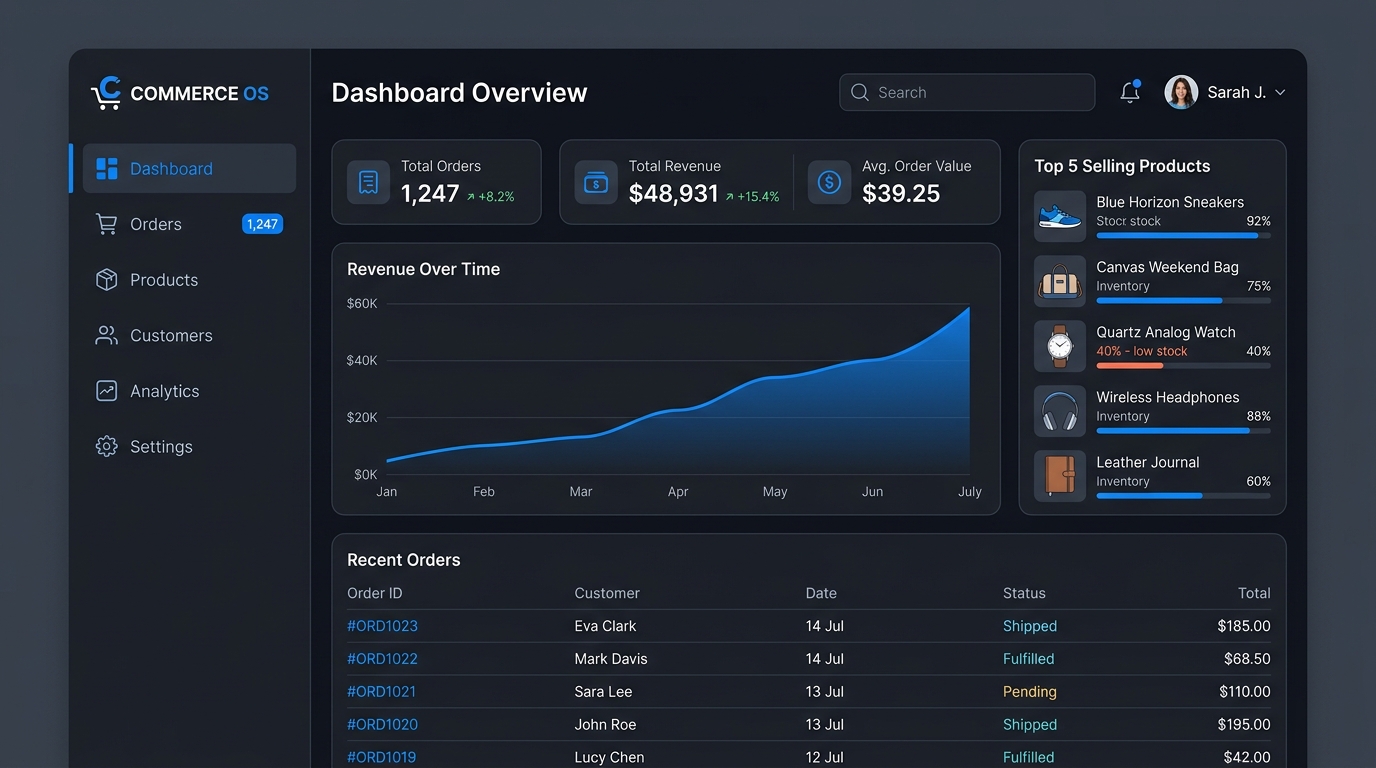
Full admin dashboard — order processing, fulfillment status, customer management, refunds, inventory alerts. Owned by you, accessible on your server.
📧 Email & Automation Hooks
Custom triggers that connect to your email platform of choice (Klaviyo, Mailchimp, or custom SMTP) — abandoned cart, order confirmation, review requests — all without monthly app fees.
📊 Analytics & Reporting
Custom analytics dashboard showing revenue, conversion rates, top products, customer lifetime value — data that lives in your database, not Shopify's.
📱 Mobile-First Performance
Most ecommerce traffic comes from phones. Designing for desktop first and fixing it for mobile later is a failing strategy. Custom development starts mobile and scales up.
Shopify vs Custom — The Direct Comparison
Feature | Shopify | Custom Ecommerce |
|---|---|---|
Upfront cost | Low ($0 to start) | Medium ($4k–$12k) |
3-year total cost | $9,000–$15,000+ | $5,000–$14,000 |
Transaction fees | 0.5%–2% extra | None (just payment processor) |
Page speed (mobile) | 45–65/100 avg | 90–98/100 |
SEO control | Limited | Full |
URL structure | Fixed by Shopify | Fully custom |
Schema / rich results | Basic | Complete |
Code ownership | ❌ You rent it | ✅ Yours forever |
Custom features | App store only | Unlimited |
Checkout customization | Shopify Plus only ($2k+/mo) | Standard |
Data ownership | Partial | Complete |
Scales without rising costs | ❌ | ✅ |
Best for | Testing / early stage | Serious growing business |
The Question Behind the Question
Most business owners asking "Shopify vs custom" are really asking: "How do I build an ecommerce store that actually makes money long-term?"
The answer depends on where you are:
If you have an unproven product — start on Shopify. Validate. Get your first 100 customers.
If you have a proven product and you're ready to scale — invest in a custom ecommerce store. Own your infrastructure, own your SEO, own your data. Stop paying Shopify's rent forever.
The businesses that dominate their niche in ecommerce in 2026 aren't the ones who built the cheapest store. They're the ones who built the fastest, the ones who show up on Google, and the ones whose checkout experience doesn't leak conversions.
That's what custom ecommerce website development is built to deliver.
How Sajlog Builds Custom Ecommerce Stores
At Sajlog, we build custom ecommerce websites for product businesses that are serious about owning their online store — not renting it indefinitely.
Every store we build includes:
⚡ Sub-1-second mobile load speed — engineered for Core Web Vitals from day one
🔍 Full SEO architecture — clean URLs, product schema, category pages, no duplicate content
💳 Stripe + PayPal integration — no platform transaction fees on your sales
📦 Custom admin dashboard — manage orders, products, inventory, and customers in one place
📱 Mobile-first responsive design — optimized for the 70%+ of shoppers on phones
✅ 100% code ownership — every line delivered to you at handover, no lock-in ever
Fixed price. 2–4 week delivery. And you walk away owning an asset, not a subscription.
→ View our pricing and start your project at sajlog.com
Before You Decide — Ask These 5 Questions
1. How much will I spend on Shopify apps in the next 12 months? Add up reviews, upsell, email, loyalty, search — if it's over $100/month, custom development makes financial sense fast.
2. Is organic SEO part of my long-term strategy? If yes — Shopify's URL limitations and speed issues will cost you rankings over time.
3. Do I need any feature that doesn't exist in Shopify's app store? Custom pricing tiers, B2B portals, subscription boxes with complex logic, multi-vendor marketplaces — none of these work cleanly on Shopify.
4. Am I comfortable never owning my store's code? If your store is generating real revenue, having it on a platform you can't control is a business risk.
5. What's my 3-year plan? If the answer involves serious growth — plan for custom infrastructure now, not after you've invested years building on a rented platform.
Ready to build an ecommerce store you actually own? Start a project with Sajlog → — Most clients receive their first design mockup within 3–5 business days. Fixed price. Full code ownership.
Ready to Build a Website That Actually Gets You Clients?
Fixed scope. 2-week delivery sprints. 100% intellectual property ownership with zero monthly subscriptions.
Related Engineering Guides
How Much Does a Custom B2B Website Cost in 2026?

SaaS Development Company: How to Choose the Right One
