
Website Redesign Services: 10 Signs You Need One in 2026

Website Redesign Services: 10 Signs You Need One (And What It Actually Involves in 2026)
Here's a question that makes a lot of business owners uncomfortable: when did you last look at your website the way a stranger would?
Not a quick glance to check if a phone number is correct. Actually sitting down, opening it on your phone, clicking through the pages, trying the contact form. Because there's a version of this story that plays out constantly — a business owner who's proud of the site they launched three years ago, while their potential clients are quietly leaving within eight seconds and calling a competitor instead.
If you've been wondering whether your site needs a redesign, the chances are fairly high that the answer is yes. Not because design trends change constantly (though they do), but because what websites need to do in 2026 is meaningfully different from what they needed to do in 2021 or even 2023.
This guide covers the ten clearest signs it's time for a redesign, what professional website redesign services actually include, what it costs, and how to make sure you get a real return on the investment.
10 Signs Your Website Needs a Redesign
1. It's Not Mobile-Friendly
This one isn't optional anymore. Over 60% of web traffic now comes from mobile devices, and Google's mobile-first indexing means your mobile experience directly determines your search rankings — not your desktop version. If your site was built before 2020 and hasn't been rebuilt since, there's a real chance it wasn't designed with mobile as the primary experience.
The test is simple. Pull it up on your phone right now. Do you have to pinch and zoom to read text? Do the buttons feel too small to tap? Does the layout break or stack weirdly? If yes — that's why your bounce rate is high, and that's a redesign conversation waiting to happen.
2. Your Bounce Rate Is Above 60–70%
Bounce rate measures the percentage of visitors who land on your site and leave without clicking anything. A high bounce rate isn't always a problem — a one-page site, for example, naturally has a high bounce rate. But if you have multiple pages and most visitors are leaving within seconds, something is wrong.
Either the site is slow, confusing, or visually outdated enough that people don't trust it. Often it's all three at once. A well-executed redesign focused on user experience and clear calls-to-action can drop your bounce rate dramatically — and that directly translates to more inquiries.
3. Your Website Is Slow
Page speed is no longer just a user experience issue — it's an SEO ranking factor, and Google is increasingly explicit about it. Research shows that pages taking more than three seconds to load lose roughly half their visitors before they even see the content. Half.
A slow site usually means outdated code, unoptimized images, poor hosting, or bloated plugins from years of additions. Sometimes you can fix this without a full redesign. But often, if the underlying structure is old, a rebuild on a modern, performance-optimized codebase is the more efficient solution.
4. You're Not Getting Leads from Your Website
If people visit your site but don't fill out forms, call you, or make purchases — the site isn't doing its job. The whole point of a business website is to convert visitors into clients. If yours isn't doing that, something in the design, messaging, or structure is creating friction.
Common culprits: CTAs that are buried or unclear, contact forms that are too long or confusing, lack of trust signals (testimonials, case studies, credentials), or a homepage that doesn't immediately communicate what you do and who you serve. A conversion-focused redesign addresses all of these systematically.
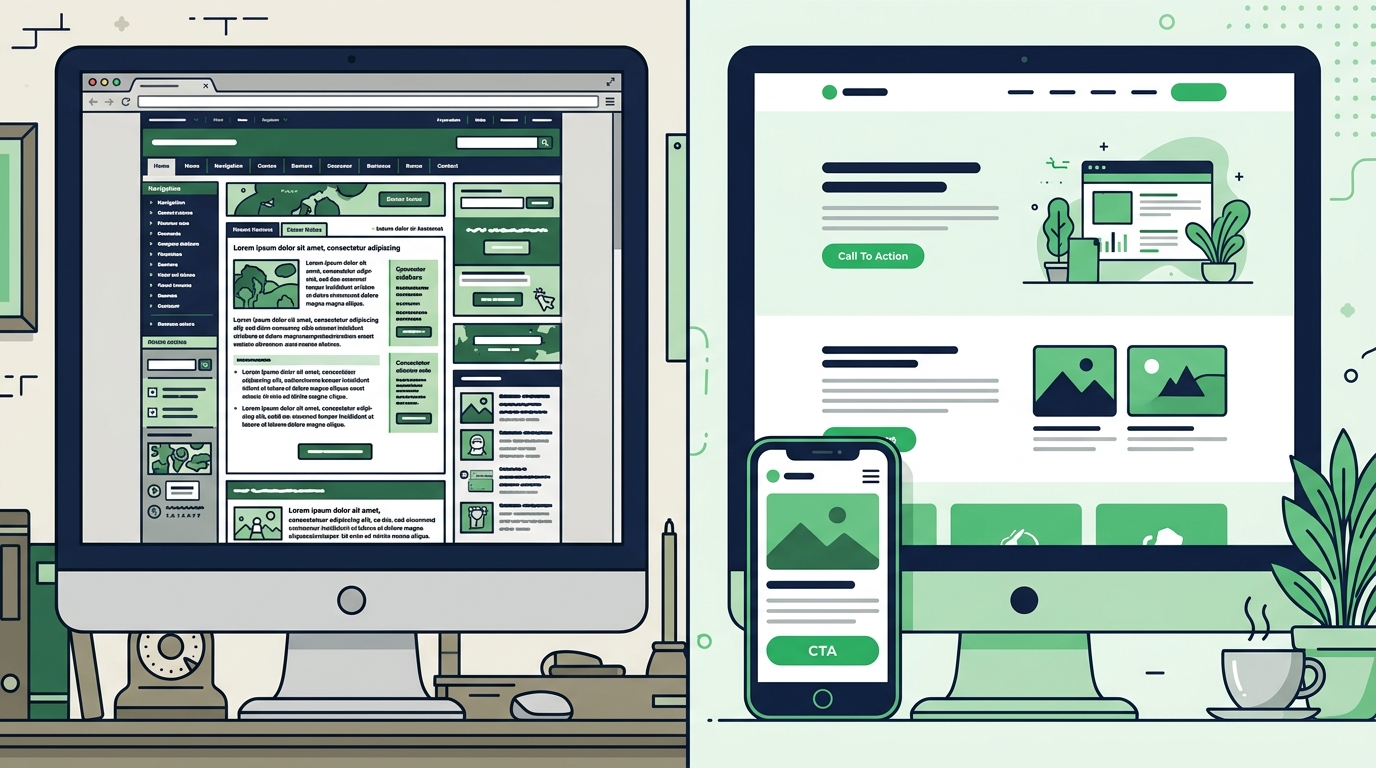
5. It Looks Dated Compared to Competitors
Perception matters enormously. 75% of users make judgments about a company's credibility based on their website. If a potential client is comparing you to three competitors and your site looks like it was built in 2018, you're starting at a disadvantage — regardless of how good your actual service is.
Take 15 minutes and honestly compare your site to your top three competitors. Is yours clearly older? Harder to navigate? Less visually polished? If you feel even slightly embarrassed showing your website to someone, that's your gut telling you something important.
6. Your Branding Has Changed
Companies evolve. New logo, new color palette, expanded services, new target market, different positioning. But too often, the website stays frozen in the old version of the business. The result is a disconnect — your branding materials say one thing, your website says another.
This creates confusion for potential clients and erodes trust. If your business has gone through any meaningful rebranding in the last few years, your website needs to reflect that. Not just slapping a new logo on old pages — but a proper redesign that aligns the entire site with where your business is today.
 7. Your Site Isn't Ranking on Google
There are many reasons a site might not rank well — content issues, lack of backlinks, poor technical SEO. But site structure, page speed, mobile-friendliness, and Core Web Vitals are all technical factors that a redesign can fix. If you've been trying to improve your SEO for months without meaningful results, the underlying site architecture might be the problem.
Modern websites are built with SEO in mind from the ground up — clean URL structures, proper heading hierarchies, fast load times, schema markup, and mobile performance. Retrofitting all of that onto an old site is often harder than building fresh.
8. You're Embarrassed to Share Your Website
Simple one, but honest. If you're handing someone a business card and quietly hoping they don't visit the website, that's a problem. Your site should be something you're genuinely proud to share. It's your 24/7 salesperson. It works while you sleep. Treat it accordingly.
9. The Site Is Hard to Update
Some websites become so tangled over the years — custom code, layers of plugins, a DIY page builder that nobody understands anymore — that making even a simple change takes hours or requires calling a developer. If updating your own website is painful, you're less likely to keep it fresh with new content, new offers, or current information.
A redesign built on a clean, well-structured CMS gives you control back. Updates that used to take a day take twenty minutes.
10. Your Conversion Rate Is Declining
If you're tracking your analytics (and if you're not, you should be), declining conversion rates over time are a clear signal. More visitors coming in, fewer of them taking action. Markets change, user expectations shift, and what worked in 2020 may not convert in 2026.
When B2B sites post-redesign, research shows a 68% increase in lead value on average. Ecommerce sites see even more dramatic results — some studies show a 3.4x revenue increase after a performance and UX-focused rebuild. That's not coincidental. It's the result of designing with conversion as the priority, not just aesthetics.
What Do Professional Website Redesign Services Actually Include?
The word "redesign" is used loosely, so it's worth understanding what a proper professional process looks like versus a quick theme change.
Discovery and strategy — Before anyone opens a design tool, a good redesign starts with understanding your business, your customers, and what you're trying to achieve. Who are you trying to reach? What should a visitor do when they land on your homepage? What are your competitors doing well or poorly? This phase prevents redesigns that look great but don't actually perform.
UX and site architecture — How your site is structured matters as much as how it looks. A professional redesign maps out your pages, user flows, and navigation before design begins. The goal is to make it effortless for a visitor to find what they need and take action.
Visual design — This is what most people think of when they hear "redesign." New layout, typography, color system, imagery. But in a quality process, every visual decision serves a purpose — it's not decoration, it's communication.
Development — The actual build. A custom-developed site offers better performance, security, and flexibility than a template. This is where Sajlog differs from simple drag-and-drop solutions — we build proper, clean code that loads fast and scales with your business.
Content — Many redesigns also involve rewriting website copy to match the new structure, target better keywords, and convert more effectively. Some agencies offer this as part of the package; others don't. Worth asking upfront.
Testing and launch — Before going live, a serious redesign includes testing across devices, browsers, and screen sizes. Checking forms, links, load speeds, and redirects. A soft launch or staging environment is standard practice for any site worth building.
What Does a Website Redesign Cost in 2026?
The range is wide, and that's because "redesign" covers everything from a $500 theme swap to a $100,000 enterprise rebuild.
For small to medium businesses, realistic ranges look something like this:
A basic redesign — same platform, updated visuals, improved layout — typically runs $2,000 to $8,000. This makes sense for businesses with a solid site structure that just needs modernizing.
A full redesign with custom development, new content, and proper SEO foundations runs $8,000 to $25,000 for most businesses. This is the range where meaningful performance improvements happen.
Enterprise-level redesigns for complex platforms, e-commerce, or large site builds go well above that — often $50,000 to $150,000+.
The ROI math matters here. Industry data consistently shows that a strategic redesign delivers measurable returns within 3 to 9 months — through improved conversion rates, better search rankings, and reduced bounce rates. A $10,000 redesign that brings in 5 extra leads per month, two of which convert at $1,000 each, pays for itself in about a year. And the returns compound.
What to Expect During the Redesign Process
A typical professional website redesign takes 6 to 12 weeks from kickoff to launch, depending on complexity and how quickly the client can provide content and feedback. Here's roughly how that breaks down:
Weeks 1–2: Discovery, strategy, and sitemap planning. This is where goals get defined and the structure gets mapped.
Weeks 3–4: Wireframes and design concepts. You'll see visual mockups of key pages before any development begins. This is your chance to give feedback on direction.
Weeks 5–8: Development. The approved designs get built. This takes longer than people expect, because doing it properly takes time.
Weeks 9–10: Content, testing, and revisions. Copy goes in, forms get tested, mobile responsiveness gets checked across real devices.
Week 11–12: Final approval and launch. Redirects get set up for SEO continuity, analytics gets configured, and the new site goes live.
This timeline can compress if the client is highly responsive and content is ready early. It can extend if scope changes mid-project or feedback cycles are slow. Clear communication on both sides makes the biggest difference.
Before You Commit to a Redesign — Ask Yourself These Questions
Not every site needs a full rebuild. Sometimes targeted improvements to speed, copy, or mobile layout can deliver meaningful results without the investment of a complete redesign. Ask yourself: is the structure of my current site salvageable? Is the problem cosmetic or structural?
If it's cosmetic — the site works well, loads fast, and converts reasonably, but just looks dated — a visual refresh may be enough. If the structure is wrong, the code is messy, or the platform is limiting what you can do — a rebuild makes more long-term sense.
Either way, the starting point is the same: an honest assessment of what's working, what isn't, and what your goals actually are. Not what your site looks like, but what it's supposed to do for your business — and whether it's doing it.
Sajlog specializes in custom website redesign services for businesses across the US and Canada. We don't do templates. Every site we build is designed around your specific goals, your audience, and your market. [Book a free consultation to see what a redesign could do for your business.]
Ready to Build a Website That Actually Gets You Clients?
Fixed scope. 2-week delivery sprints. 100% intellectual property ownership with zero monthly subscriptions.
Related Engineering Guides
How Much Does a Custom B2B Website Cost in 2026?
SaaS Development Company: How to Choose the Right One
