Small Business Web Design Packages: What a Quote Should Include
You ask two developers for a five-page website. One sends a short price list. The other sends a longer proposal with content, testing and support. Both say “mobile friendly” and “SEO included.” How do you know whether the higher price buys useful work or whether the lower price leaves important tasks with you?
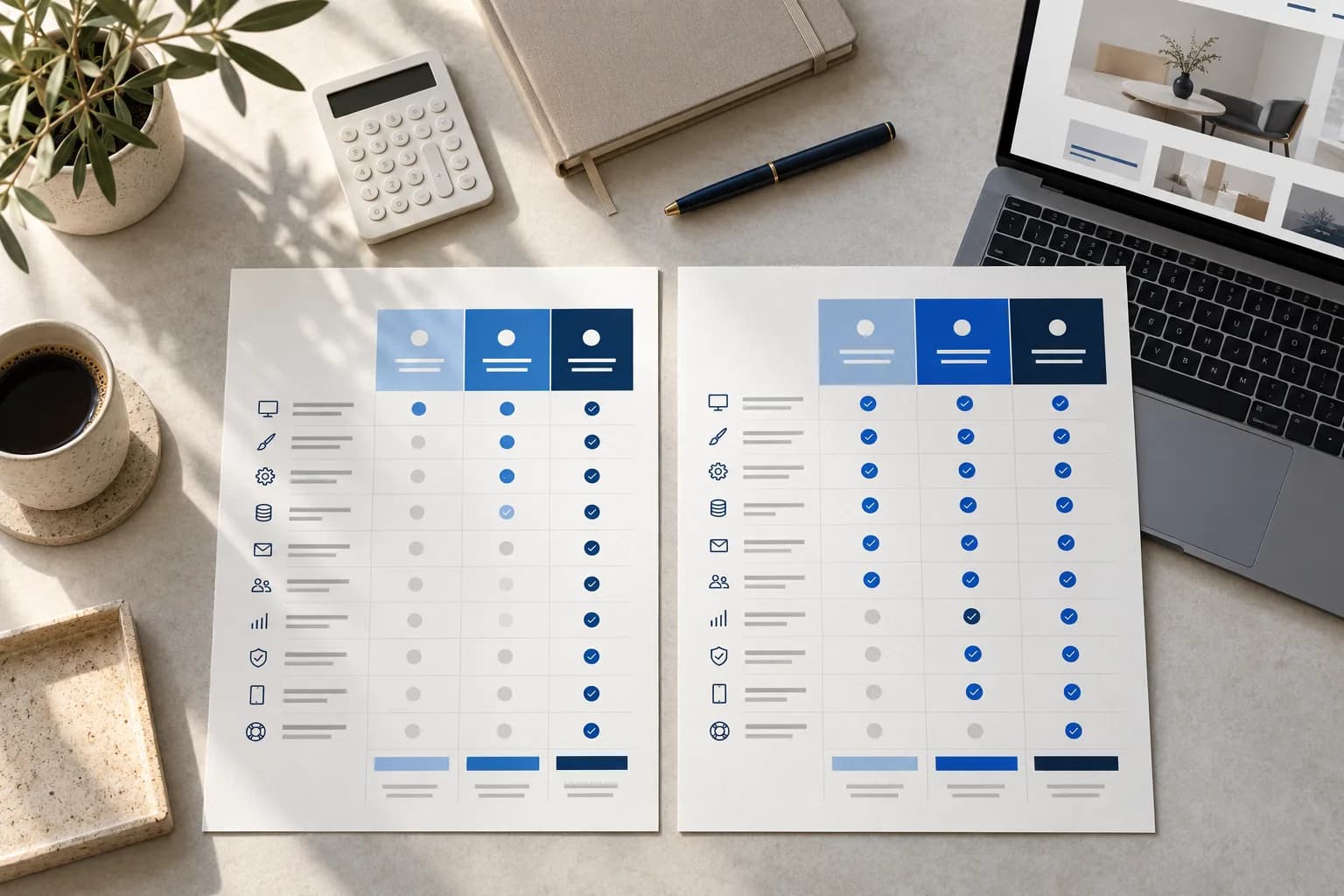
Compare small business web design packages by the agreed work, ownership and ongoing costs—not only the headline price or page count. A useful quote explains what will be delivered, what you must provide, how the finished website will be checked and what you will pay after launch.
Use the questions below to put competing proposals on the same footing. They are especially useful for a service business that needs clear pages and inquiries rather than a large online store or custom software platform.
1. Define the pages and the work inside them
“Five pages” sounds specific, but it does not explain the work. A homepage, two service pages, an about page and a contact page might fit one business. Another needs staff profiles, location information, a project gallery or separate forms.
Ask for the page names and the main sections on each page. Confirm whether the price covers an existing design adapted to your brand, a new layout or a combination. None of those approaches is automatically wrong; you need to know what you are buying.
How many distinct layouts are included?
Will each main service have its own page or share one overview?
Who adds the initial text, photographs and downloadable files?
Are legal notices, confirmation screens and error pages accounted for?
Count features separately from pages. An appointment scheduler, payment flow and customer login can each involve more work than another informational page.
Better scope wording: “Five named public pages, one contact form delivered to the agreed inbox, and an editor for service text and images.” This is easier to assess than “a complete business website.”
2. Make content responsibility explicit
A website can be technically finished while its content is still waiting on the owner. Before accepting a small business website design quote, decide who writes the copy, selects the images and checks the business details.
Separate copywriting from editing text you provide. Similarly, uploading photographs is different from arranging a photoshoot or licensing stock images. If the developer drafts content, name the person who will approve its accuracy.
A manageable content plan records the page, the person supplying it and its due date. Include service descriptions, contact details, opening hours, brand files and permission to use any testimonials. Ask what happens to the delivery schedule if these arrive late.
You should also know what you can update after launch. “Admin panel included” needs an explanation: can you change a phone number, edit service pages, add images and publish articles, or only modify a few predefined fields?
3. Turn “SEO, speed and mobile friendly” into deliverables
These labels appear in many website packages for small business. Ask the provider to describe the actual checks rather than relying on the labels.
Technical SEO
A proposal can specify editable page titles and descriptions, sensible headings, working internal links, canonical URLs, a sitemap and checks for accidental indexing blocks. If the project replaces an old site, agree on a list of old addresses and relevant redirects.
Distinguish this launch setup from ongoing keyword research, content production and promotion. Google’s guidance on hiring an SEO cautions against guaranteed first-place rankings. Ask for work the provider can deliver, not a promised search position.
Performance
Ask which pages and devices will be tested and how results will be recorded. A score from one test is not the whole visitor experience. Google’s Web Vitals measurement guide distinguishes controlled lab tests from measurements of real visits; the results can differ.
Useful checks include sensible image sizes, usable navigation while the page loads and a contact journey tested on an actual phone. If the provider offers a performance target, the quote should describe its measurement conditions.
Usability and accessibility
Agree on checks for keyboard navigation, visible focus, form labels, readable contrast and understandable errors. The W3C explains that automated accessibility tools need human review. A scanner result alone should not be presented as a complete accessibility assessment.
4. Set revision limits, milestones and approval tests
“Two rounds of revisions” is useful only when both sides understand what a round means. Does it cover one consolidated feedback list on a design? Does changing the approved layout later count as a new round? Is a new booking feature treated as a change in scope?
Agree on a sequence such as content approval, design approval, functional testing and launch. Tie payments to the milestones written in the proposal, and ask how extra work will be priced and approved before it begins.
Keep launch tests observable. For example, the owner can edit a service description, a test inquiry reaches the correct inbox, telephone links work on mobile and the pages listed in scope load on the live domain.
Also ask when the timeline starts. A delivery estimate may depend on the agreed scope, complete content and access to the existing domain or hosting. Record those dependencies so “ready in a week” does not become a different promise for each person.
5. Compare the first-year total on the same basis
The setup fee is only one part of a website budget. Ask for separate figures for domain renewal, hosting, software licenses, maintenance and any required subscriptions. Mark each item as included, optional, paid directly to a third party or still unpriced.
The following USD figures are hypothetical examples, not Sajlog prices or market averages. Assume both offers cover the same five-page site, design quality, inquiry form, revisions, testing, ownership and handover. Copywriting is needed, and recurring charges cover a full 12 months.
Example A: lower setup price, separate content
Website build: $1,800.
Required copywriting: $600.
Hosting and the agreed maintenance allowance: $30 × 12 = $360.
First-year comparison total: $2,760.
Example B: higher setup price, content included
Website build, including the same copywriting scope: $2,400.
Hosting and the same maintenance allowance: $20 × 12 = $240.
First-year comparison total: $2,640.
Example B is $120 lower over the first year under these assumptions. Domain registration, taxes, advertising and any other unlisted purchases are excluded from both totals. If they differ between providers, add them before deciding.
The lesson is to compare equivalent scope, not to choose the higher setup fee automatically. If you already have approved copy, Example A becomes $2,160 for the listed items. Your actual needs change the comparison.
For a store with products, checkout and payment processing, use a separate scope. Our ecommerce website development cost guide explains the build and operating costs to consider.
6. Know what you own and what happens if you leave
Ask whose account holds the domain and who receives renewal notices. Confirm the access you receive to hosting, the content editor and any connected services. A business should understand these arrangements before launch, not discover them when changing providers.
For a custom build, ask what source files and documentation are handed over. For a hosted platform, ask what content can be exported and which functions depend on that platform. Licensed themes, photographs, fonts and software may have their own usage terms; clarify those separately.
A monthly plan may include hosting, maintenance and content changes. Ask about its minimum term, cancellation process, export or transfer assistance and any fee to keep using the website. Compare the written terms rather than assuming that all subscription packages work the same way.
The handover should also identify what the owner can do independently and what still requires developer help.
7. Separate launch fixes from ongoing maintenance
A correction to an agreed feature that does not work is different from adding a new feature. Ask how the provider distinguishes those requests and how long launch support lasts.
For maintenance, ask for a concrete allowance: which updates, backup checks, monitoring or content changes are covered? A response-time commitment describes when a request is acknowledged; it does not necessarily promise when every problem will be resolved.
Confirm who restores a backup, who handles a broken third-party integration and how urgent issues are reported. If you choose to manage the site yourself, make sure the proposal includes enough training and access for the tasks you intend to take on.
A short brief to send before requesting quotes
Give each provider the same brief. It makes the replies easier to compare and reduces avoidable follow-up questions.
We need a website that explains our services and sends inquiries to our team. Please list the proposed pages, included features and content we need to supply. Separate the build fee from recurring charges, define revisions and testing, and confirm the access and files we receive at handover. Please also explain the delivery dependencies, launch support and pricing process for work outside the agreed scope.
Add your current website address, service area, essential integrations, preferred launch window and a realistic budget range. Tell the provider whether you are replacing an existing site or starting from scratch.
Frequently asked questions
Are fixed small business website design packages a good choice?
They can be when the included pages and features match your needs. Ask for the exclusions and extra-work rates. A custom quote can be more useful when the project involves unusual workflows, integrations or substantial content migration.
Does a package need to include ongoing SEO?
Not necessarily. A launch package can cover technical setup while ongoing SEO remains a separate service. The quote should make that distinction clear so a one-time setup is not mistaken for continuing research, content work and reporting.
Should I choose a one-time fee or a monthly plan?
Compare the total over your intended period of use, what support you need and the exit terms. A monthly fee can cover useful ongoing work, while a one-time build may still require hosting, licenses and maintenance payments.
Ask for a quote built around your business
The most useful package is one you can understand and check. You should know what is being built, what you need to provide, how it will be approved and what happens after launch.
Sajlog’s custom website development service covers agreed pages, responsive design, technical launch setup and the admin controls your project needs. Domain registration, hosting and paid services are identified separately where needed. Tell us about your website so we can define a scope and quote around your requirements.