
SaaS Development Company: How to Choose the Right One
SaaS Development Company: How to Choose the Right One and What It Actually Costs in 2026
Most SaaS products fail before they get a chance to succeed.
Not because the idea was bad. Not because the market wasn't ready. They fail because the founders made expensive mistakes at the build stage — hired the wrong development partner, underestimated complexity, ran out of runway before finding product-market fit, or built a product so technically fragile that scaling it became more expensive than building it again from scratch.
The company you choose to build your SaaS product shapes every one of those outcomes. It determines how fast you ship, how much you spend, how scalable the architecture is, and whether you're six months from now celebrating your first 500 customers or debugging the same login screen for the third time.
This guide covers what a SaaS development company actually does, how to evaluate one properly, what everything costs in 2026 with real numbers, and the red flags that separate reliable partners from expensive lessons.
Why SaaS Development Is Different From Regular Web Development
This is the question most founders don't ask until it's too late.
Building a website and building a SaaS product are not the same thing. A website is a brochure that sometimes has a contact form. A SaaS product is a living software system that has to handle multiple users simultaneously, manage subscriptions and billing, scale when demand spikes, stay secure under attack, and evolve continuously based on user feedback.
The technical decisions made in the first month of a SaaS build shape the entire trajectory of the product. Architecture choices — how data is structured, whether the system handles multiple tenants on shared infrastructure or isolated instances, how the billing system connects to the core product, how users are authenticated — are cheap to make correctly at the start and brutally expensive to fix later.
This is why hiring a WordPress developer or a general web agency to build your SaaS is a common, costly mistake. They may be genuinely excellent at what they do. But SaaS architecture requires specific experience that most generalist developers simply don't have.
What a SaaS Development Company Actually Does
The scope of work varies significantly depending on where you are in the product lifecycle, but a full-service SaaS development company should be capable of:
Product discovery and architecture planning — Before writing a single line of code, a competent SaaS company will spend time understanding your business model, your target users, your competitive landscape, and the technical requirements that flow from all of those. This is not a formality. The architecture decisions made in discovery determine how much your product costs to build, how fast it scales, and how expensive it is to maintain. Skipping discovery is how projects go 3x over budget.
Frontend development — The user interface your customers actually interact with. In a quality SaaS product, the frontend is fast, intuitive, and designed around the workflows your users actually have — not just aesthetically pleasing. Poor UX is the #1 reason users churn in the first 30 days.
Backend development and API design — The server-side logic, database architecture, and APIs that power everything the user sees. This is where most of the complexity lives, and where experience matters most. A well-designed backend handles 100 users and 100,000 users the same way. A poorly designed one becomes a crisis at scale.
Authentication and user management — User accounts, roles, permissions, team management, single sign-on for enterprise clients. Simple in concept, surprisingly complex in execution. Getting this wrong creates both security vulnerabilities and frustrated users.
Subscription billing integration — Stripe, Paddle, or similar. Handling free trials, upgrades, downgrades, pausing subscriptions, proration, refunds, and failed payment flows. This is not "just connect Stripe." A proper billing implementation takes significant engineering time to do correctly.
DevOps and infrastructure — Hosting, deployment pipelines, monitoring, backups, uptime. The infrastructure your product runs on determines whether it's available when users need it. Most SaaS companies host on AWS, Google Cloud, or Azure. The choice of cloud provider and architecture affects both cost and reliability.
Quality assurance and testing — Automated test coverage, manual QA, security testing. The difference between a product that works and one that breaks in ways users discover at the worst possible moments.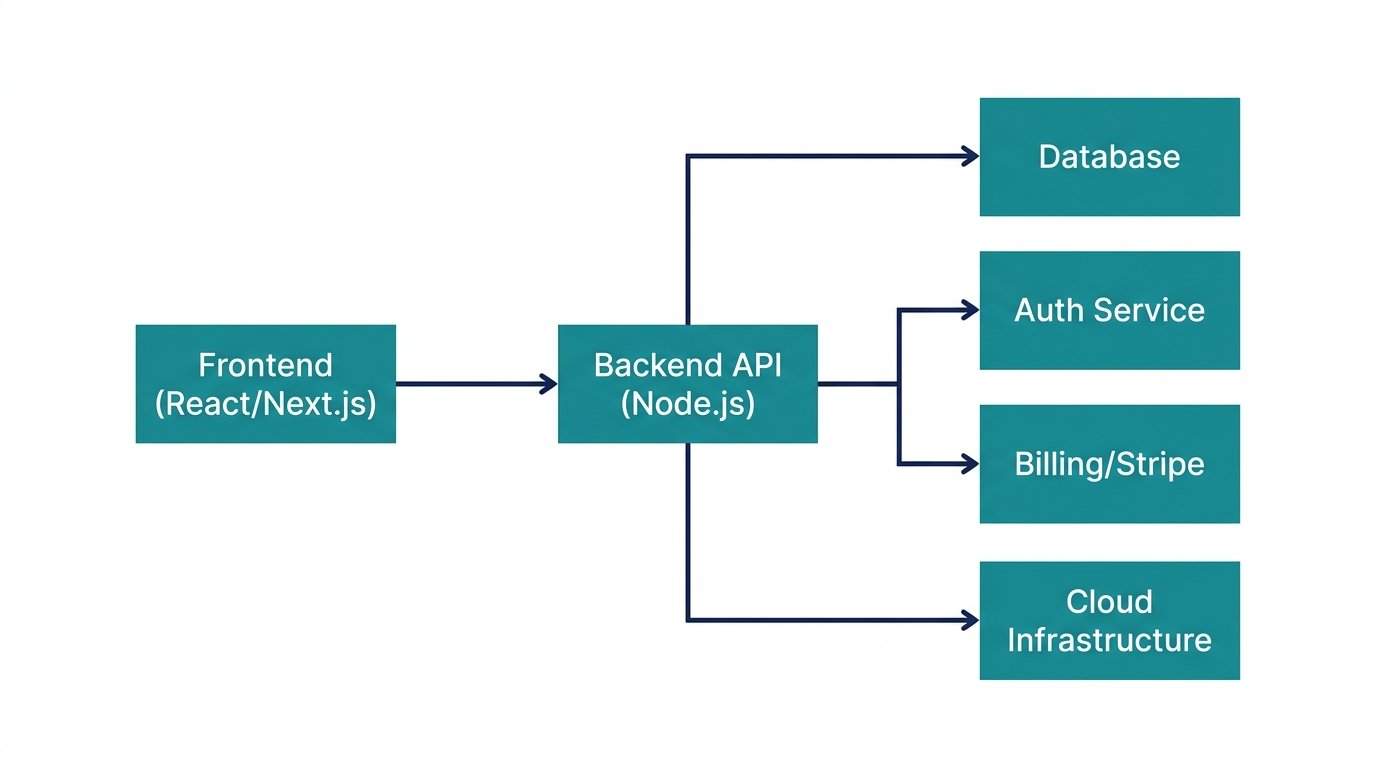 What Does It Actually Cost to Build a SaaS Product in 2026?
The honest answer: significantly more than most people expect when they start planning, and significantly less than they fear if they scope intelligently.
<cite index="23-1">The global SaaS market is on track to hit $375.57 billion in 2026 at an 18.7% CAGR.</cite> That growth is pulling more products into an already competitive market — and founders who underestimate development costs run out of runway before they find product-market fit. Let's look at real numbers.
Validation prototype ($5,000–$15,000) The sole purpose of this stage is to answer one question: will anyone pay for this? A prototype is not a product. It's the minimum you need to show to potential customers and get real feedback before committing to a full build. Some founders use no-code tools like Bubble or Webflow at this stage. If your idea can be validated with a prototype rather than a built product, do that first. <cite index="18-1">The most valuable $5,000 you'll spend is the only spend that prevents a $100,000 mistake.</cite>
Lean MVP ($25,000–$75,000) <cite index="22-1">A SaaS MVP with core features — authentication, subscription billing through Stripe, a user dashboard, and the single workflow that solves the validated problem — sits between $25,000 and $60,000 for most startups in 2026.</cite> This is the version you put in front of real paying customers to learn what they actually need before building more. A good MVP is deliberately incomplete. The features you don't build yet are features you don't spend money guessing about.
Mid-complexity product ($80,000–$200,000) <cite index="21-1">Most mid-complexity products land between $80,000 and $200,000 for a market-ready release.</cite> At this level you're getting a complete product with multiple user roles, advanced workflows, third-party integrations, a proper admin dashboard, and solid mobile performance. This is the range for most funded startups building their first serious market-ready release.
Enterprise-grade platform ($280,000–$600,000+) <cite index="17-1">An enterprise-grade platform with single sign-on, audit trails, and compliance requirements runs $280,000 to $600,000 or more.</cite> This category includes regulated industries (fintech, healthcare, legal), products requiring SOC 2 certification, or platforms with complex multi-tenant architecture and white-labeling requirements.
The hidden costs most vendors don't quote
Here's where most founders get surprised: <cite index="23-1">design, QA, DevOps, and post-launch maintenance together add 40–60% on top of the base build. A project quoted at $80,000 can easily land at $130,000–$150,000 once those line items surface.</cite>
The other hidden cost: <cite index="21-1">post-launch maintenance runs 15–20% of the original build cost every year — not a one-time expense.</cite> A product that cost $100,000 to build will cost $15,000–$20,000 per year to maintain properly — security patches, dependency updates, infrastructure management, bug fixes, and ongoing feature development.
The Geography Factor: Where Your Team Sits Changes Everything
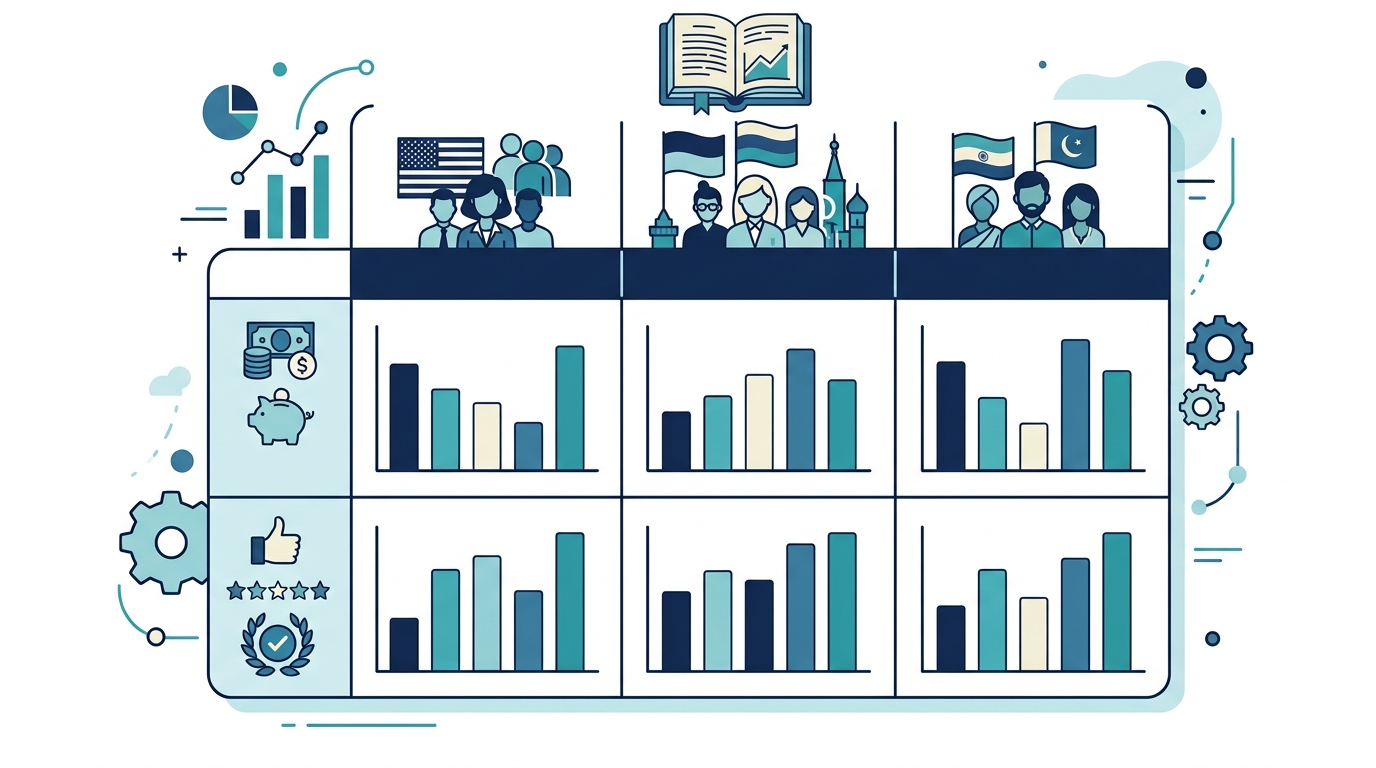
<cite index="19-1">SaaS development costs in 2026 vary by 4–5x depending on where your team is located. The same MVP that costs $150,000 with a US agency can be built for $25,000–$40,000 with a senior development firm in South Asia or Eastern Europe.</cite>
But cost isn't the only variable. The total economic picture includes:
Time zone overlap — a team 9 hours ahead means most of your working day happens while they're asleep. This adds latency to every decision and extends timelines in ways that erode the cost advantage.
Communication quality — English fluency, responsiveness, proactiveness about raising problems before they become expensive. Hard to assess from a quote, critical to assess from references.
<cite index="19-1">AI coding tools like Cursor, Claude Code, and GitHub Copilot now reduce SaaS build time by 40–60% for experienced development teams. An MVP that would have taken 12 weeks in 2023 can ship in 7–8 weeks in 2026 with AI-augmented development.</cite> This matters when comparing costs: a team that uses AI tooling effectively can deliver more in less time, which shifts the value calculation regardless of geography.
The bottom line on geography: the best-value teams are not the cheapest teams. <cite index="19-1">The top 10% of offshore agencies deliver the same output as mid-tier US firms at 30–40% of the cost. The bottom 10% can cost more in rework than they save.</cite> The variance within any geography is larger than the variance between geographies. Verify Clutch ratings, client references, and SaaS-specific case studies before making any decision based on price.
 How to Evaluate a SaaS Development Company — The Questions That Matter
Most founders evaluate development companies based on their website and their price quote. Both of those things are almost entirely irrelevant to the actual quality of the output.
Here's what actually matters:
Have they built SaaS products specifically? Not web apps. Not marketing websites. SaaS products — with subscription billing, multi-user architecture, user management, and ongoing maintenance. Ask to see examples. Ask to talk to a founder whose SaaS product they built. If they can't provide references from previous SaaS clients, that's a significant gap.
How do they handle architecture decisions? Ask them to walk you through how they'd architect the core data model for your product. A junior team will start talking about which framework they'd use. An experienced SaaS team will start asking questions: how many user types are there? How is data separated between accounts? What are the compliance requirements? Architecture conversations reveal experience more than portfolio pages do.
What does their discovery process look like? A company that's ready to start writing code after a 30-minute call is a company that either doesn't understand what they're building or doesn't care. A quality SaaS development company runs a proper discovery phase — usually 2–4 weeks — before committing to a development scope or price. This isn't them stalling. It's them doing the work that prevents the project from going sideways at month 3.
How do they communicate, and how often? Weekly progress updates? Daily standups? A project management tool you have access to? Define expectations before you start, not after you've already lost visibility into what's happening. Projects that go silent for three weeks and then deliver a big batch of features have a much higher failure rate than projects with consistent, incremental delivery.
Who actually builds your product? Some development firms quote experienced senior developers in their pitch and then staff the project with junior developers or outsourced contractors once the contract is signed. Ask specifically: who are the developers who will work on my project? Can I meet them? What's their SaaS experience?
Red Flags That Are Worth Walking Away From
A quote with no discovery phase. If a company can give you a fixed price for your SaaS product after a one-hour conversation, they haven't understood what they're building. Real scoping takes real time.
Vague timelines. "We'll have the MVP done in 2–3 months" without a defined scope is meaningless. A legitimate company can tell you which features are in scope, which are out, what the milestones are, and what happens if scope changes during the build.
No examples of SaaS-specific work. Beautiful portfolios of marketing websites and e-commerce stores are not evidence of SaaS capability. They're two completely different disciplines.
Pressure to sign quickly. Legitimate development partners want you to evaluate them carefully, because bad-fit projects are expensive for both sides. A company that's pushing you to sign before you've done your due diligence is optimizing for their pipeline, not for your product.
No post-launch plan. Any SaaS product that launches is a SaaS product that will need ongoing maintenance, feature development, and support. A company with no clear plan for what happens after launch isn't thinking about your product's long-term success.
The Right Way to Start
The biggest mistake founders make when approaching a SaaS development company is coming with a fully-specified feature list and asking for a quote to build all of it.
That's backwards.
Start with the problem you're solving and who has it. Then let a good development company help you scope the minimum viable version that lets you validate whether people will pay for the solution. Build that. Learn from real users. Then build more.
<cite index="25-1">A well-scoped B2B SaaS MVP typically costs $50,000–$120,000 and takes 3–6 months to build with a competent team. That buys real market feedback — far more valuable than assumptions in a planning document.</cite>
The founders who succeed with SaaS products aren't the ones who built the most complete version of their idea first. They're the ones who got real users quickly, learned what those users actually needed, and built that. A good SaaS development company is a partner in that process — not just a factory that builds what you spec.
Final Thought
The SaaS market in 2026 is enormous, growing fast, and genuinely full of opportunity. But the opportunity doesn't reward the companies with the biggest feature sets or the most ambitious roadmaps. It rewards the ones who built something real, got it in front of real users, and iterated relentlessly based on what those users actually said.
The development company you choose is the difference between a product that gets to that point and one that burns through runway without getting there. Choose based on SaaS-specific experience, verified references, and honest communication — not portfolio aesthetics and competitive pricing.
At Sajlog, we've built SaaS products, web applications, and custom software for clients across the US, Canada, and the UK. We run a proper discovery process before any build, and we don't start writing code until we're confident we understand what we're building and why. [Book a free discovery call to talk through your product idea.
Ready to Build a Website That Actually Gets You Clients?
Fixed scope. 2-week delivery sprints. 100% intellectual property ownership with zero monthly subscriptions.
Related Engineering Guides
How Much Does a Custom B2B Website Cost in 2026?

Website Maintenance Services: What's Included & Costs in 2026
